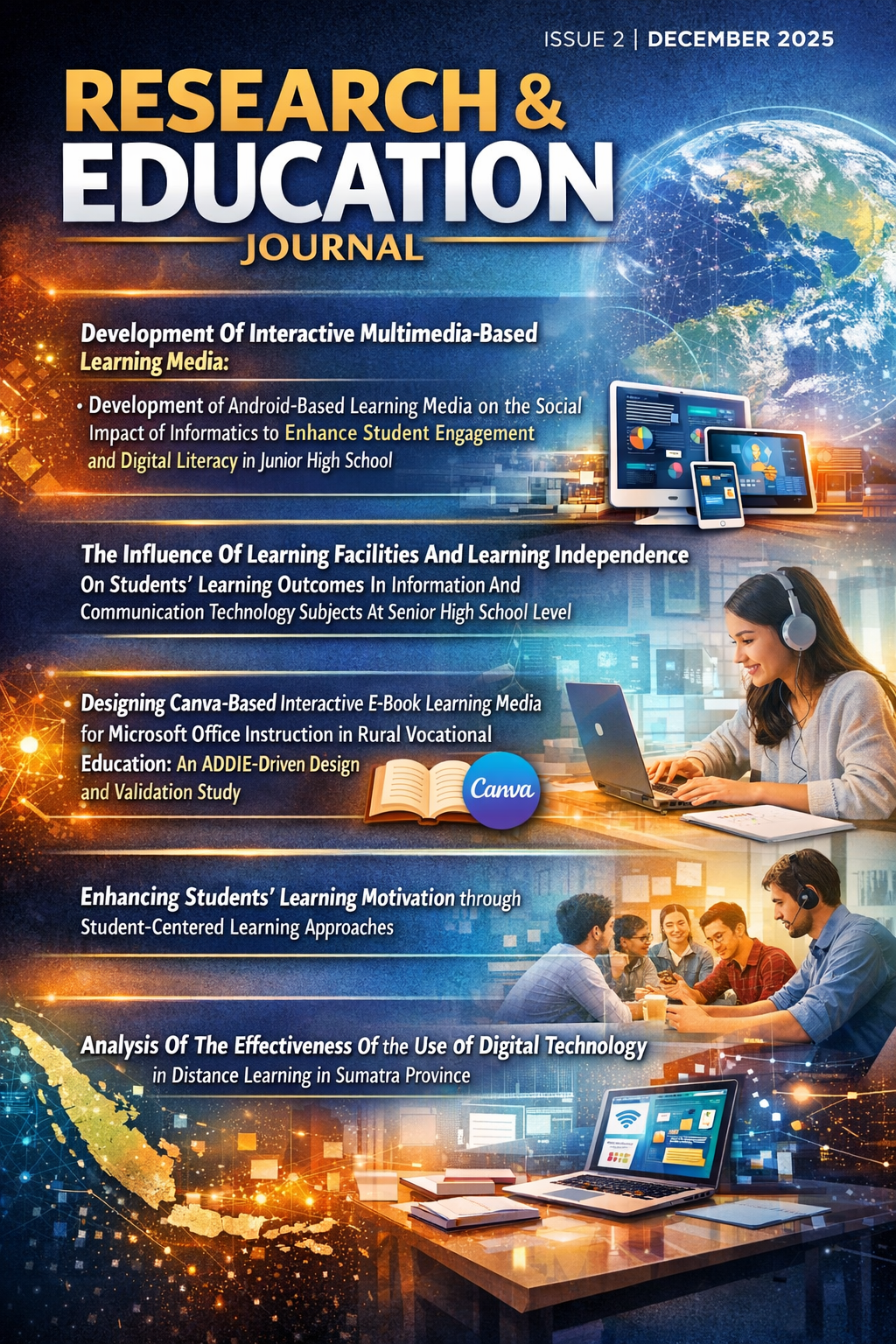
Development Of Interactive Multimedia-Based Learning Media
Keywords:
interactive multimedia, Smart Apps Creator, Informatics education, computer systems, instructional design.Abstract
The integration of digital technologies in education has heightened the need for pedagogical innovations that enhance conceptual understanding and student engagement, particularly in subjects involving abstract technical content such as Computer Systems. This study aimed to develop and evaluate an interactive multimedia learning application using Smart Apps Creator (SAC 3) for Grade X Informatics students at SMA Negeri 01 Boyan Tanjung. Employing a Research and Development (R&D) methodology grounded in the ADDIE model, the study systematically carried out needs analysis, instructional design, multimedia development, classroom implementation, and formative evaluation. Data were collected through expert validation sheets, student response questionnaires, observations, and documentation, and analyzed using descriptive statistics.
Results from expert validators indicated high levels of feasibility, with media experts awarding scores of 88.09% and 91.66%, and material experts assigning 93.18% and 84.09%, placing the product in the “Very Valid” category. Classroom implementation involving both small- and large-scale trials demonstrated strong student engagement and positive perceptions, with overall student response reaching 85.14%, categorized as “Very Good.” The interactive multimedia effectively supported learners in visualizing system components, reduced cognitive load, and increased motivation compared to traditional teaching resources. The findings affirm that SAC-based multimedia constitutes a practical and pedagogically robust solution for enhancing the teaching of Computer Systems, particularly in schools with limited infrastructure. Future research should incorporate experimental measurements of learning gains and broaden implementation across diverse educational contexts.
Downloads
References
Aldoobie, N. (2015). ADDIE model. American International Journal of Contemporary Research, 5(6), 68–72.
Azizah, K. (2020). Pengembangan media pembelajaran interaktif menggunakan Smart Apps Creator. Jurnal Pendidikan Informatika, 4(2), 112–123.*
Chen, C.-H., Huang, C.-Y., & Liu, M. (2018). A review of learning theories applied in game-based learning studies. Computers in Human Behavior, 87, 50–62. https://doi.org/10.1016/j.chb.2018.05.012
Forsyth, D., Waller, J., & Boettcher, J. (2018). Media-rich learning environments and student engagement. Educational Technology Research and Development, 66(5), 1127–1146. https://doi.org/10.1007/s11423-018-9586-2
Karlinda, K. (2021). The effectiveness of SAC-based multimedia in improving students’ comprehension. International Journal of Interactive Mobile Technologies, 15(8), 89–103.* https://doi.org/10.3991/ijim.v15i08.20745
Kong, S. C., Chiu, M. M., & Lai, M. (2022). Digital learning and computational thinking: A systematic review. Computers & Education, 182, 104468. https://doi.org/10.1016/j.compedu.2022.104468
Mayer, R. E. (2021). Multimedia learning (3rd ed.). Cambridge University Press. https://doi.org/10.1017/9781108859012
Molenda, M. (2015). In search of the elusive ADDIE model. Performance Improvement, 54(2), 40–42. https://doi.org/10.1002/pfi.21461
Mustafa, N., Suryani, A., & Wahyudi, R. (2023). Interactive multimedia for enhancing conceptual understanding: A meta-analysis. Education and Information Technologies, 28, 3057–3077. https://doi.org/10.1007/s10639-022-11389-1
Nurhayati, N., & Cahyono, H. (2019). Validitas instrumen pembelajaran berbasis multimedia. Jurnal Evaluasi Pendidikan, 10(1), 44–54.
Pristiwanti, D., Hasanah, U., & Fitriani, N. (2022). Students’ learning challenges in technology subjects. Journal of Technical and Vocational Education, 12(3), 285–296.
Saputra, A., Ramadhani, S., & Putra, Y. (2023). Effects of interactive multimedia on student engagement: A quasi-experiment. Education and Information Technologies, 28, 1785–1801. https://doi.org/10.1007/s10639-022-11285-8
Sugiyono. (2019). Metode penelitian dan pengembangan (R&D). Alfabeta.
van Deursen, A. J., & Helsper, E. J. (2018). The second-level digital divide: Differences in people’s online skills. Communication Research, 45(5), 719–740. https://doi.org/10.1177/0093650217714362
Voogt, J., & Roblin, N. P. (2019). A comparative analysis of international frameworks for 21st century skills. Journal of Curriculum Studies, 51(3), 329–353. https://doi.org/10.1080/00220272.2018.1447846
Wahyono, P., Husamah, H., & Masruri, M. S. (2021). Teacher readiness in implementing Informatics Curriculum. Journal of Education and Learning, 15(4), 512–523. https://doi.org/10.11591/edulearn.v15i4.20745
Yaumi, M. (2018). Media dan teknologi pembelajaran. Kencana.