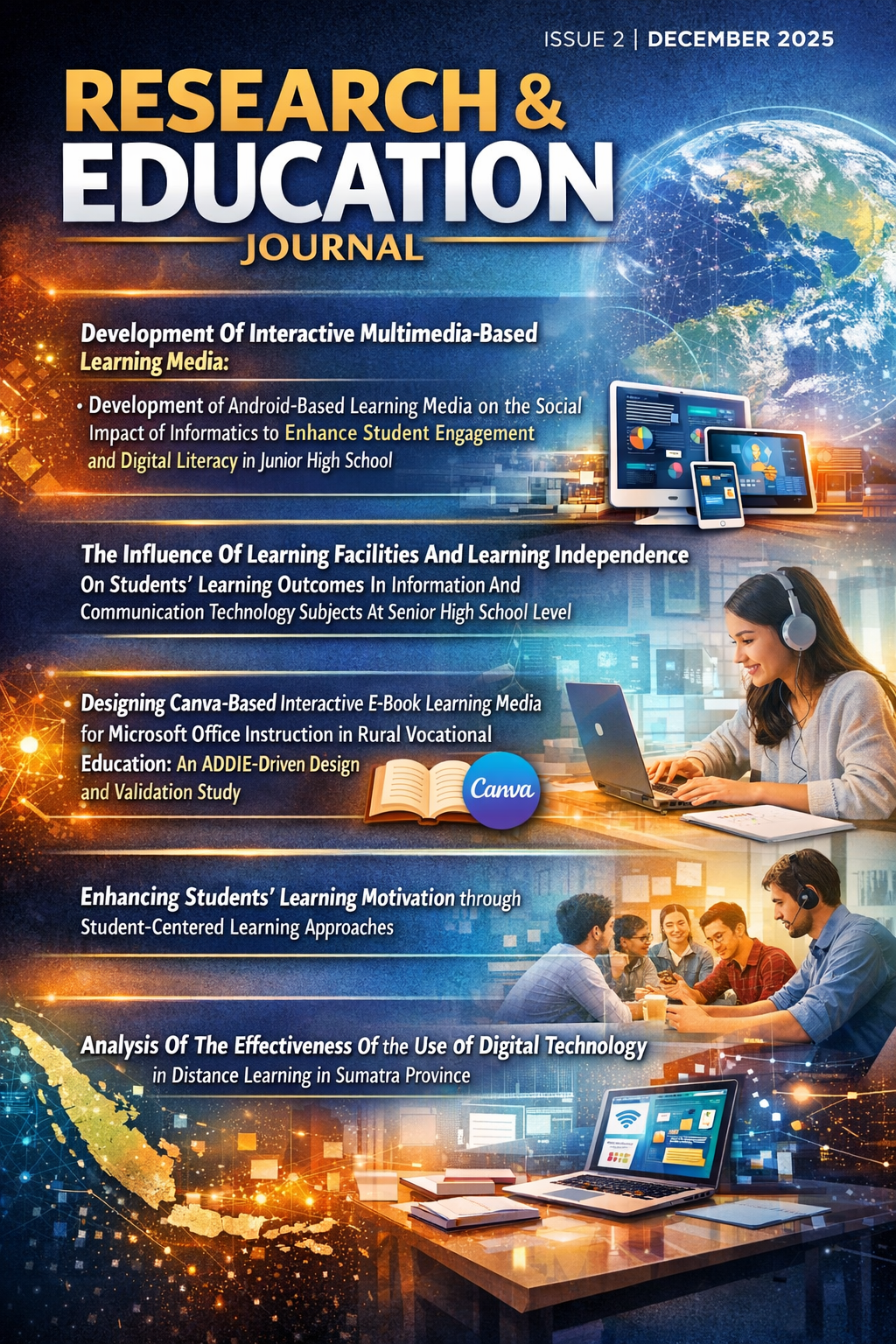
Development Of Android-Based Learning on The Social Impact of Informatics
Keywords:
Android-based learning media, social impact of informatics, ADDIE model, mobile learning;, educational technologyAbstract
The rapid advancement of mobile technology necessitates innovative pedagogical approaches that leverage students' familiarity with digital devices. This study addresses the pedagogical challenges in teaching the social impact of informatics at SMP Negeri 11 Sungai Kakap, where limited school facilities and teachers' reliance on conventional textbooks have resulted in suboptimal learning engagement. Employing the ADDIE (Analysis, Design, Development, Implementation, Evaluation) research and development model, this research developed an Android-based interactive learning application utilizing MIT App Inventor. The media incorporated multimedia elements including textual explanations, animated videos generated through artificial intelligence, audio narration, and interactive quizzes aligned with the Merdeka Curriculum for eighth-grade informatics. Validation was conducted through expert assessment and user trials involving five students in a small-scale trial and twenty-five students in a large-scale implementation. Media experts rated the application with an average score of 3.47 (SD = 0.12), categorized as "very feasible," while material experts awarded a mean score of 3.44 (SD = 0.15), also classified as "very feasible." The large-scale user trial yielded a mean score of 3.54 across four dimensions: usability and navigation (3.75), presentation clarity (3.53), aesthetics (3.38), and instructional quality (3.50). These findings demonstrate that the developed Android-based learning media meets technical and pedagogical standards for classroom implementation and significantly enhances student engagement in understanding the social implications of information technology. The study contributes to the growing body of evidence supporting mobile learning as an effective strategy for delivering complex socio-technical concepts in secondary education contexts with limited technological infrastructure.
Downloads
References
Abelson, H., Wolber, D., & Spertus, E. (2021). App Inventor: Create Your Own Android Apps (2nd ed.). O'Reilly Media.
Ali Mudlofir, H., & Rusydiyah, E. F. (2022). Desain Pembelajaran Inovatif: Dari Teori ke Praktik*. Jakarta: PT Raja Grafindo Persada.
Arsyad, A. (2015). Media Pembelajaran. Jakarta: PT Raja Grafindo Persada.
Christiani, Y. H. (2022). Pengembangan Media Pembelajaran Berbasis Android pada Materi Dampak Sosial Informatika di Kelas IX SMP Yakhalusti Pontianak. Universitas PGRI Pontianak.
Hidayat, R., & Nizar, F. (2021). Desain Pembelajaran dengan Model ADDIE. Bandung: Alfabeta.
Jubilee Enterprise. (2015).Menguasai Pemrograman Android. Jakarta: Elex Media Komputindo.
Kuswanto, J., & Radiansah, F. (2018). Media Pembelajaran Berbasis Android pada Mata Pelajaran Sistem Operasi Jaringan Kelas XI. Jurnal Pendidikan Teknologi Informasi, 5(2), 45–58.
Mayer, R. E. (2021). Multimedia Learning (3rd ed.). Cambridge University Press.
Norman, D. A. (2013). The Design of Everyday Things (Revised ed.). Basic Books.
Pranoto, Y., & Suyanto, A. (2016). Pengembangan Aplikasi Pembelajaran Berbasis Android. Jurnal Teknologi Pendidikan*, 18(1), 23–35.
Putra, N. M. (2018). Statistik Pendidikan. Yogyakarta: Deepublish.
Sitompul, P. (2022). Perlindungan Data Pribadi di Era Digital. Medan: Media Komunika.
Sugiyono. (2017). Metode Penelitian Kuantitatif, Kualitatif dan R&D. Bandung: Alfabeta.
Verawati, N. S. N., & Comalasari, E. (2019). Manfaat Android dalam Pendidikan. Jurnal Pendidikan dan Teknologi, 11(2), 621–625.
Wulandari, A. (2018). Pengembangan Instrumen Evaluasi Media Pembelajaran Berbasis Android. Bandung: Universitas Pendidikan Indonesia.